

Tuberculosis stalks South African prisons
Overcrowding, poor healthcare blamed for TB that killed 78 prisoners across country's 'breeding ground' jails last year
Dudley Lee, 59, walked out of Pollsmoor Prison in Cape Town, South Africa a free man in 2003. He is now a prisoner of the disease he acquired there.
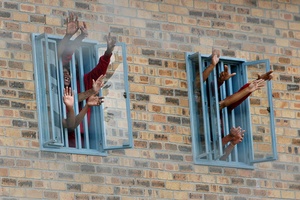
South African prisons are overcrowded by 136 per cent on average.
Awaiting trial on charges of fraud and money-laundering, Lee was
incarcerated for four years and contracted tuberculosis (TB) in
the prison's unsanitary conditions.
Although Lee was
exonerated for a lack of evidence, he received no apology from
the South African government. After his stint in prison, his
lungs were scarred and he had aged dramatically. By the time he
got out, he had lost his health, family and business.
Tuberculosis
has become a major killer in South Africa's prison system.
Seventy-eight inmates died of TB last year - making
the infectious disease the leading cause of death in most of the
country's prisons, according to the government-appointed
Judicial Inspectorate of Correctional Services. Pollsmoor, where
Lee was held, has a TB transmission rate of 90 per cent per
year, according to research by Professor Robin Wood, director of
the Desmond Tutu HIV Centre.
Wood has labelled the
prison a "breeding ground" for the disease, mostly because of
overcrowding and a lack of ventilation.
High
incarceration rate
With 160,545 inmates, South Africa
has one of the highest incarceration rates on the continent.
Prisons
are overcrowded by 136 per cent on average. Pollsmoor Maximum is
overcrowded by 230 per cent, according to the Judicial
Inspectorate.
Those convicted of stealing an apple
are put in the same cells as mass murderers, and juvenile
facilities often house prisoners in their 30s.
One-third of inmates in South Africa are still awaiting trial,
according to the Judicial Inspectorate.
Researchers
from Wits Justice Project, a non-governmental organisation, say
prisoners have spent up to five years in jail awaiting trial.
Documents seen by this reporter from the Department of
Correctional Services show some have waited for as long as 10
years.
Those waiting for justice have no access to
psychologists, even if they have been raped in prison or
infected with a disease.
The scourge of TB in South
African prisons came to national attention only recently, when
Lee took the minister of Correctional Services to the
Constitutional Court. He is demanding damages for the harm he
suffered from the disease, alleging prison authorities are
directly responsible.
During the trial, the state
acknowledged when it comes to prisons, the law gets broken on a
regular basis.
The Correctional Services Act 111 of
1998 and Sections 27 and 12 (e) of the Constitution state that
prisoners such as Lee have the right to access medical services,
to not be treated in a cruel, inhuman or degrading way, and to
not be detained without trial.
No screening
New
prisoners are supposed to be screened for disease when entering
Pollsmoor - and quarantined if found to be ill. But no such
screening or segregation process actually exists.
Lee
- now in his late 60s - is unemployed and living in an old-age
home. He says while in prison, after months of coughing and
asking for medical attention, he was only diagnosed with TB when
he was taken to hospital for a hernia. Once in the prison
facility, he adds, there were not enough nurses to monitor his
medicine intake.
During his incarceration, Lee was
held in cells designed to hold 20 people, but were in fact
holding 80.
Lee was taken to court 70 times during his stay. While there, he
was kept in a holding cell where people from different prisons -
many of whom were visibly ill - were kept together in heavily
overcrowded conditions.
"You are always surrounded by
people coughing and spluttering," he says. "If I needed to see
the doctor, I would have to pay the warder to open my cell and
take me there."
According to Professor Wood,
Pollsmoor has several characteristics making it an ideal space
for TB to spread.
"Conditions prevailing in Pollsmoor
Prison are extremely conducive to the ongoing transmission of
TB, including drug-resistant TB ... Crowding, long lock-up times
up to 23 hours per day, and inadequate ventilation result in
prisoners re-breathing contaminated air for prolonged periods of
time."
Added to this is a delay of up to four months
in accessing medical care, he says. As a result, the state does
not know how many prisoners actually suffer from TB during their
incarceration.
'State impunity'
Paul
Theron was the doctor in charge at Pollsmoor Medium A from 1997
to 2007, during the time that Lee was in prison. He was
suspended when he blew the whistle on health and human rights
abuses in Pollsmoor.
Theron says Pollsmoor is largely
controlled by prison gangs, which the authorities are unable to
control. "By definition," says Theron, "safe custody is not
possible in an environment which is largely controlled by
destructive elements dedicated to their own preservation. The
ongoing toleration of destructive and criminal elements within
the prison disallow any progress in terms of health
management."
The Department of Correctional Services
did not respond to repeated requests for comment.
Lee
won his case at the High Court in 2010, but it was overturned on
appeal, as Lee could not prove that he would not have contracted
TB even if the prison authorities had fulfilled their duties.
Lee's
lawyer, Adila Hassim, argued at the Constitutional Court that
this requirement for an "impossible calculation" would "immunise
the state" from being held accountable.
The state
made the case that a ruling for it to pay damages to Lee would
open up the possibility for "unlimited liability" to complaining
offenders.
Nooshin Erfani-Ghadimi, of Wits Justice
Project, says TB in prisons has the potential to affect society
as a whole.
"Prison walls are porous, and what
happens inside will come out," Erfani-Ghadimi says. "Right now
the state is getting away with impunity, and if we don't make
sure conditions that inmates living in are in line with the
Constitution - we are facing a disaster."
Aljazeera
http://www.aljazeera.com/indepth/features/2012/10/201210315250776426.html

