

TB drug delamanid must be more affordable and made available in more countries
Médecins Sans Frontières acknowledges the lower price offered to the government of South Africa for delamanid, but calls for it to be significantly lower and expanded to all countries in need.
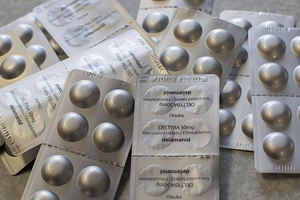
Geneva, 10 October 2019 - Médecins Sans Frontières (MSF) acknowledges the lower price offered to the government of South Africa for newer anti tuberculosis (TB) drug, delamanid, but calls for it to be significantly lower and expanded to all countries in need.
Mylan, which licenses the drug from the patent-holder Otsuka, will charge US$940 [1] for a six-month treatment course ($157 per month) as of 1 June 2020 in South Africa. Delamanid is used in combination with other drugs to treat people with drug-resistant TB (DR-TB), including the hard to treat extensively drug-resistant TB (XDR-TB).
As long as these new drugs are priced out of reach for TB
programmes, an all-oral treatment regimen for people
everywhere with pre-XDR and XDR-TB… will remain a
distant reality.
Dr Stobdan Kalon, MSF medical adviser, India
Delamanid is one of the most expensive drugs used to treat drug-resistant tuberculosis (DR-TB), priced at $1,700 [2] for a six-month treatment course ($283 a month) through the Global Drug Facility, a TB drug and diagnostic procurement mechanism operating out of a UN agency. It is just one of multiple drugs needed to treat the disease. Its high price is a key driver of the high overall cost of treating people with multidrug-resistant TB (MDR-TB) and XDR-TB. A full 20-month treatment course for one person can cost $8,000 to $12,000 through GDF, depending upon the length of treatment and the other drugs that make up the treatment regimen.
The high price has had a chilling effect on treatment scale-up: although delamanid was conditionally approved by the European Medicines Agency in April 2014, as of the end of August 2019, only 2,902 people have ever been treated with delamanid according to the DR-TB Scale-Up Treatment Action Team of global TB experts, which receives updates from National TB Programmes and large treatment providers, such as MSF.
Otsuka and Mylan must further drop the price of
delamanid to ensure that TB programmes are able to
afford and scale-up the use of all-oral treatment
regimens.
Dr Stobdan Kalon, MSF medical adviser, India
The
World Health Organization’s (WHO) treatment
guidelines
prioritise the use of newer drugs as part of all-oral
regimens for the treatment of MDR-TB and XDR-TB.
MSF urges more countries to make the switch
from older, toxic treatments that need to be injected to
all-oral regimens that contain the newer drugs, including
delamanid. These newer drugs are critical to improving the
otherwise abysmal cure rates of 55% and 34% for MDR-TB and
XDR-TB, respectively. Use of the newer TB drugs is also
urgently needed for children with MDR-TB in order to
improve treatment outcomes and reduce the risks of side
effects.
However, the $940 price for delamanid offered by Mylan to
South Africa remains too high. It is also not clear
whether Mylan plans to offer this price to all countries.
Countries facing high rates of resistance specially to
fluoroquinolone [3] drugs, like India, should take
effective measures including overriding patents through
compulsory licenses so that generic manufacturers can
enter the supply chain and bring the price down further.
Researchers from the University of Liverpool have
calculated that delamanid could be produced and sold at a
profit for much less – ranging from $5-16 per month
if the drug is scaled up by national TB programmes.
Dr Stobdan Kalon, MSF Medical Advisor, India said:
“We constantly struggle to successfully treat people
with XDR-TB that have fluoroquinolone resistance and
children with MDR-TB at our Mumbai clinic, which is a
grave concern given the unacceptably high rates of
treatment failure and death. In order to improve the
chance for a cure, these patients need effective treatment
regimens and immediate access to newer drugs, bedaquiline
and delamanid.
Even at $940, delamanid remains one of the most expensive
DR-TB drugs, and its high price will continue to have a
chilling effect on the scale-up of this drug in national
TB programmes. As long as these new drugs are priced out
of reach for TB programmes, an all-oral treatment regimen
for people everywhere with pre-XDR and XDR-TB and children
with MDR-TB will remain a distant reality and people will
continue to suffer the devastating side effects of older
drugs that have to be injected, including permanent
deafness. Otsuka and Mylan must further drop the price of
delamanid to ensure that TB programmes are able to afford
and scale-up the use of all-oral treatment
regimens.”
1 Price includes charges for shipping, handling
and insurance (15% approx.) but excludes Value Added
Tax (VAT) (15%)
2 Ex works price: Price of the drug that does not include additional charges of loading, shipment, insurance, import duties etc.
3 Fluoroquinolones (FQ): A class of antibiotics that play an essential role in the treatment of DR-TB. High levels of resistance to fluoroquinolones in countries like India is a serious concern because it is associated with treatment failure and death for people with DR-TB who are resistant to this class of drugs.
Source:
Médecins Sans Frontières

